
Sometimes I like to spend a couple weeks reading the same passage every day, depending on what issues I am dealing with or whatever obstacle I am facing at the time. For every struggle one faces there are at least a couple of scriptural passages that can serve as “go to” passages...just to read, sit with and reflect upon.
Every human being has vulnerabilities to certain sins or bad habits, or we can get stuck in a rut in our lives. Both can certainly be a source of frustration and discouragement if we have difficulty breaking a bad habit or we can’t get out of a rut we find ourselves in. In short all of these things can be spiritual strongholds in our lives that need to be broken. They can appear to be insurmountable challenges that may seem impossible to overcome.
Of late I have been reading Chapters 2-6 in the book of Joshua. This is an account of Joshua leading the Israelites into the Promised Land after 40 years in the desert. In order to do this they had to first cross the Jordan river, which, due to the season, was in flood. In spite of this everyone in the nation had to cross – young and old, weak and strong, tall and short. Then they had to capture the strong hold of Jericho – a walled city. Two formidable but necessary obstacles that needed to be overcome.
To summarize the main points in these chapters:
Joshua chapter 2
- Joshua secretly sends two men to reconnoitre the Promised Land which, at that time, was called Canaan.
- They enter Jericho and go into the house of the prostitute Rahab planning to stay there for the night.
- The king of Jericho somehow gets wind of the two men, what their mission is and where they are staying.
- He sends a messenger to Rahab ordering her to turn them over to him.
- Rahab hides the men and tells the messenger that the men left just before the city gate was to be closed for the night.
- The king, buying into this story, (after all Rahab was a prostitute) sends out men to search for and find them.
- Rahab makes a deal with the two men. She has been kind to them; return the kindness and spare the lives of her father, mother, brothers and sisters and all who belong to them.
- The two men pledge their lives, so long as she does not tell of their mission and no one goes out of her house into the street when they return in force. Otherwise their lives are forfeit. However, if she obeys them and harm comes to her or her family their blood is on the two men’s heads.
- Her house is in the wall so she lets them down by a rope through a window.
- They tell her to tie a scarlet cord to the window so when the time comes the Israelites can identify her house.
- After 3 days avoiding those searching for them they return safely to the Israelite camp.
Joshua chapter 3
- The Jordan river is in spate and the Israelite nation must cross it to enter the Promised Land.
- God instructs Joshua what to do next. The priests carrying the Ark of Yahweh approach the Jordan. As soon as the soles of their feet touch the waters of the Jordan, the Jordan is cut off.
- The upper waters flowing down stop in a single mass.
Joshua chapter 4
- After the crossing is made and the priests carry the ark of the covenant out onto solid ground, the Jordan resumes its flow.
Joshua chapter 5
- Now they camp on the other side of the Jordan.
- They celebrate the passover, eat the produce of the land and the manna stops. [Does not the scarlet cord and command for Rahab and her family to remain in their hose while Jericho are razed bring to mind the account of the 10th plague in Exodus? The first passover – Exodus 12:7,13.]
Joshua chapter 6
- At this point Jericho has shut and barricaded its gates.
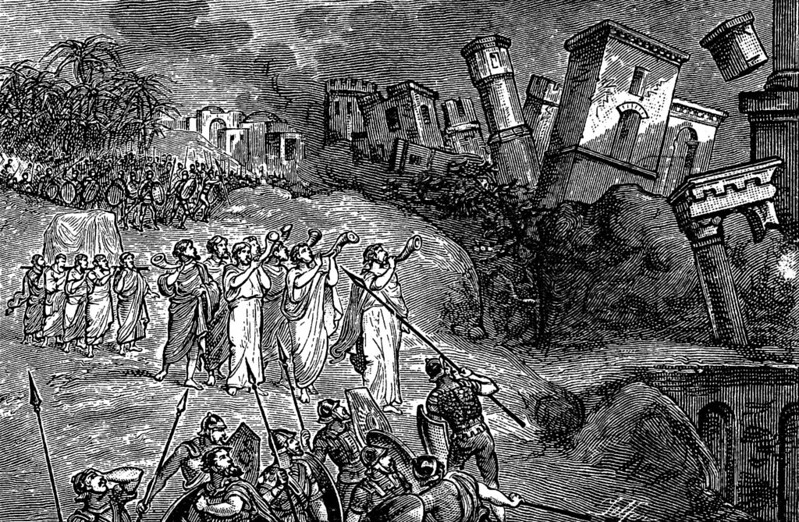
- On God’s instructions, the Israelites circle the city once each day for six days with the ark of the covenant, blowing their trumpets. On the seventh day they do this seven times, then the people raise up a great yell and the city walls fall.
- The original two men go into Rahab’s house and bring them out.
- The Israelites kill everyone else, men, women, children, even the animals.
What are the takeaways I have from this story?
- The words of Rahab to the two men says a lot. “I know that Yahweh has given you this country, that we are afraid of you and that everyone living in this country has been seized with terror at your approach.” The people of the land had heard about all of their victories and even their crossing of the Red Sea 40 years prior.
- There is a time set by God when an event is ready to happen. It can be in the world at large or in our lives. And once that time comes, by His providence everything falls into place.
- Help can come in times of need from the most unlikely of places and persons. And it may be a person that you least expect. In this case it was a prostitute named Rahab.
- When the right time comes for prayers to be answered or a stronghold in our lives to come down or for healing to happen, God is instrumental in the breakthrough. It’s not our work, it is His. We can’t do it alone. In this case He parted the Jordan, allowing the nation to cross into Canaan, and He took down the walls of Jericho, giving them a foothold. But the people had to be obedient and do what He commanded them to do. They had to submit to His will in His time.
- I wonder what the two men first thought of when they heard of how Jericho was to be conquered, by the fall of the city wall? After all Rahab’s home was in the wall, and her blood was on their head. Clearly when the wall fell God spared that part of the wall where Rahab and her family were. He respected the the oath made between her and the two men.
- With the exception of Rahab and her family, everyone was killed including the animals. It may sound brutal, but when understood from a spiritual perspective - when God’s grace is at work and He destroys obstacles or strongholds in our lives He does not cut any corners.
- This was “Take Two” for the Israelites. In the first attempt, “Take One”, Moses had assigned a number of men from the original generation that God led out of Egypt to reconnoitre the Promised Land. But they were too afraid to seize the opportunity and because of that God decreed that that entire generation would die in the desert, with the exception of Joshua and Caleb (Numbers, chapters 13 and 14) This highlights the need for obedience and trust! More on this point later.
There is a really good reflection I came upon when meditating on these passages. It is titled “What is the spiritual meaning of Jericho?” and was written by Anurag Rao. I will quote, what for me were a few particularly inspiring sets of paragraphs, but will leave it up to you to read the whole article.
It is in Jericho that Jesus heals blind Bartimaeus (Mark 10:46-52) and calls Zacchaeus, the tax collector, from his place in a sycamore tree (Luke 19:1-10). Both encounters are marked by radical change—healing, repentance, and restoration.
The Israelites, newly arrived from forty years in the wilderness, faced the city as their first obstacle upon entering Canaan. Following God’s unusual instructions to march around the city for seven days and then shout, the walls of Jericho miraculously collapsed, granting Israel a decisive victory. This event marks a turning point, symbolizing not just a military triumph but the transition from promise to possession, from wandering to inheritance.
Further on Anurag Rao discusses the theme of new beginnings in this story and relates this to Rahab,
Jericho also embodies the theme of new beginnings. For the Israelites, conquering Jericho was the first step into their inheritance—a new chapter after years of wandering and waiting. Spiritually, Jericho can represent the moments in our lives when God calls us to step forward into new territory, leaving behind old patterns or seasons and embracing the future He has prepared.
This theme of new beginnings is echoed in the story of Rahab, the Canaanite woman who sheltered Israelite spies and professed faith in the God of Israel. Her home was the only part of Jericho’s wall left standing, and she and her family were spared from destruction.
Rahab’s story is a powerful reminder that no matter our background or past, faith opens the door to redemption and a new start. In fact, Rahab is later named in the genealogy of Jesus, underscoring the idea that Jericho is not just about judgment, but about God’s mercy and the inclusion of outsiders in His plan.
As Anurag Rao points out in his conclusion, the story of Jericho serves as both a warning and a promise. I would include as well the account in Numbers chapters 13 and 14 as well as the miraculous crossing of the Jordan.
In Numbers 13, 14 the people were given the opportunity to enter into the Promised Land but their fear of those occupying Canaan stopped them. God punished them by condemning the whole generation to die in the desert. This was not a capricious act of anger by God but a just punishment. The source of their fear was a lack of obedience and trust in God. Why this lack of trust? This generation was repeatedly rebuked by God and was “stiff necked”, which means haughty, stubborn or obstinate1, and thus they refused to change their ways and amend their lives. They were unprepared for something new!
There are many examples of their disobedience and murmuring in the books of the Pentateuch. Some examples are, Exodus 16:2-3, Exodus 16:19-20, Exodus 17:3-4, and Exodus 32:1-10.
The lesson for us is that trust does not come easily. It requires setting aside time for prayer every day. Turing to God both in our trials and in good times. Not forgetting about God, especially in good times, or despairing in bad ones, but persevering always in prayer and other spiritual exercises, such as reading scripture, cultivating virtue and frequent reception of the sacraments.
This sets a solid foundation for times when we really need to lean on God, and God will not disappoint!
Notes:
1. Dictionary.com, https://www.dictionary.com/browse/stiff-necked
2. The credit for the title of this comes from a song by Samantha Ebert which I heard for the first time just after giving a talk on this topic.
Authors
-
John Rae
-
Mark Pilon
Adele's Photography