
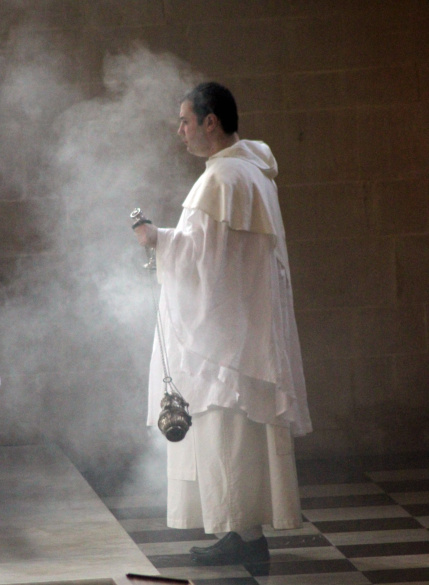
A few weeks ago, we were visiting family in Calgary and our 12-year-old grandson wanted to go to Mass with us. It was only his second time at a Mass. At Saint Patrick’s Church, that morning, an abundant amount of incense was used, and our grandson was curious as to what all the smoke was about. I told him that the smoke rising from the censer was symbolic of our prayers rising the Heaven and that as that scent floated over and descended on the congregation it was symbolic of us all inhaling God’s spirit. He could think of it as a form of Catholic vaping.
After lunch we got comfortable and started to binge watch the Lord of the Rings. The story of the Lord of the Rings takes place in a totally other conceptual universe than the one we are immersed in today. The cultural cosmos that we moderns live in is only a subset of a much more feature rich environment that has been forgotten. The author of Lord of the Rings, J.R.R Tolkien and his friend C.S. Lewis attempted to help us rediscover this land that has been lost. C.S. Lewis said that that older model of the universe was symphony of ordered power and love” and was a “sacramental universe where everything, matter and spirit participated in the divine meaning rather than a mechanistic one where nothing does.” This mechanistic worldview has only been in operation, as our cultural fulcrum, since the 1500’s.
Like the mysterious wardrobe in C.S. Lewis’ children’s books, the Mass is a portal into that sacramental land. What, from the outside, looks like a Church Service is actually a passageway to the divine. At the high point of the Mass the bread and wine, the symbols, mysteriously become what they symbolize, the Body and Blood of Christ. In the mechanistic universe this miracle cannot be allowed. Everything, symbol and symbolized, must stay in its own lane otherwise the machine starts to break down. That machine is starting to breakdown anyway because of its own internal issues. As it gets closer to its “best before date” it is not releasing the fragrance of the Holy Spirit, like the incense at St Patrick’s, but is giving off the odor of doubt. You can see this with people today doubting if truth does exist and/or questioning their sexuality.
n the modern wilderness created by the worship of the soulless machine St. Patrick’s and St. Benedict’s exist as examples of sacramental oases in what Psalm 63:1 refers to as “a dry and thirsty land.” These oases provide us with access to truth, goodness and beauty.
Jesus comes to us in our personal dry and thirsty land. Cardinal Raniero Cantalamessa says, “The Eucharist is the way Jesus established to remain forever Emmanuel, God-with-us”. So, as we sing the Christmas invitational hymn, “O Come O Come Emmanuel” lets us ponder on the profundity of what we are requesting!
Authors
-
David Palmer
-
John Rae
-
Mark Pilon
Adele's Photography